Find the product family that matches your deliverable
| Product family | Typical buying question | Information to prepare |
|---|
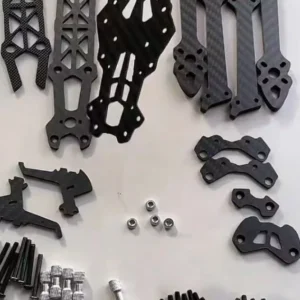
| Custom carbon fiber parts | What shape and interfaces must a finished component meet? | Part drawing and revision; mating geometry; critical dimensions; quantity; material and finish requirements |
|---|
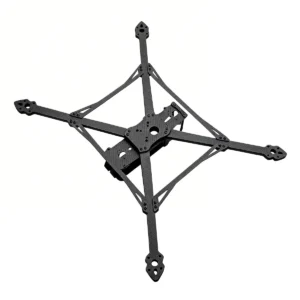
| Carbon fiber drone and UAV frames | What structural elements and mounting points are included? | Frame layout; arm and plate geometry; motor/stack hole pattern; bill of materials; desired assembly scope |
|---|
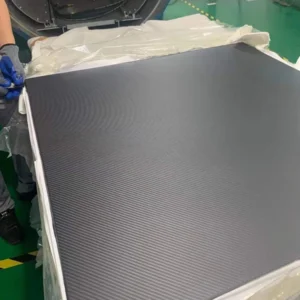
| Carbon fiber sheets and plates | What flat laminate specification is required? | Length, width, thickness, material/layup requirements if known, surface condition and intended use |
|---|
| Custom-cut sheet enquiry | What must be removed or added to the starting flat sheet? | Source sheet requirements; finished outline; holes and slots; edge condition; inspectable dimensions |
|---|
These are product-family starting points, not a promise that a pictured example, every listed material configuration or a particular stock size is immediately available. For each project, identify what is fixed in the drawing and what may be reviewed during technical scoping.
Finished components: define the fit, not only the shape
A custom component might be a plate, cover, bracket or more complex structural piece. The buying question is not just whether a supplier can create a similar silhouette. It is whether the proposed part can satisfy the actual interfaces and acceptance requirements. Show the mating components, hole positions, functional datums and any required finishing operations on a controlled drawing. If you supply a sample, record which dimensions were measured and which details still need engineering definition.
Drone and UAV frames: define the assembly boundary
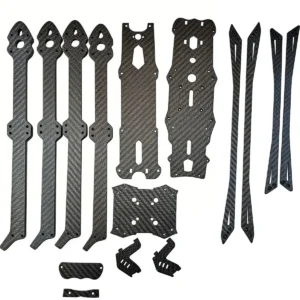
A drone frame request needs more than a nominal airframe size. Distinguish arm plates, center plates, standoffs, motor interfaces, flight-controller mounting and hardware, where applicable. State whether your enquiry covers separate carbon-fiber frame pieces or a defined assembly. A frame image cannot demonstrate payload capacity, crash resistance, motor-hole dimensions or kit contents. Those details require the actual configuration and supporting records.
Sheets and plates: specify the material form
A sheet or plate enquiry begins with its required flat geometry and end use. Confirm how length, width, thickness, layup, finish and cut-edge conditions are to be specified. A decorative woven face does not reveal every internal ply or prove the completed laminate's performance. For a critical application, identify the material documentation and acceptance checks needed for the particular grade and construction.
Custom-cut sheets: describe the finished geometry
A flat sheet cut to size becomes a different deliverable once you require precise profiles, slots, holes or finished edges. Give the starting material requirements and a separate drawing for the resulting part. Mark which hole-to-hole distances or edge features are function-critical. This is a sheet-specific sourcing question; a broad CNC machining enquiry has its own process and feasibility considerations.
Compare requirements before requesting a quote
For a useful first review, organize your project inputs into three groups:
Define the physical item. Provide the drawing/CAD revision, sample description, intended function, the unit system and any mating features. For an assembly, include what is and is not part of the deliverable.
Define material and finish expectations. Specify resin or fiber requirements only where determined, along with surface, edge or appearance conditions. If material selection is still open, describe the environment and desired design outcome rather than inventing a grade.
Define sourcing and acceptance. Distinguish prototype quantity from expected repeat demand. Identify your target schedule, critical inspection points, required material/test records and any customer confidentiality restrictions.
A quotation should reflect a particular configuration. Do not combine a thickness seen in one supplier's sheet listing, a load rating from an unrelated frame and a finish photo from another product into an assumed specification for your own part.
What to verify when reviewing a product-family offer
Before approving a sample or ordering repeated parts, make sure the supplier's evidence refers to the item under discussion. Useful checks include:
Item identity: Does the product description or photograph correspond to the same drawing revision, geometry and included components?
Material definition: Are the construction, thickness or finish requirements documented for this particular configuration?
Dimensional acceptance: Which features will be inspected, and what records or agreed criteria will demonstrate fit?
Commercial scope: Does the quotation identify the requested quantity, items included, outstanding technical questions and project-specific terms?
Any required certification, inspection or performance statement should be checked against its actual holder, scope, date and relevant specimen. A generic badge or a supplier's unrelated product page is not substitute evidence.
Product selection and manufacturing services are different questions
Choose the Products overview when you can identify the physical item you intend to source. Choose Custom Manufacturing when the project still needs a discussion about process, prototype development, fabrication, machining or OEM/ODM cooperation. A finished-parts enquiry may eventually involve those activities, but the overview should not assume that every method is available or appropriate for every shape.
For application-specific integration questions, identify the relevant environment and system constraints separately. Factory and Quality information should be reviewed for actual published process or inspection evidence, rather than treated as automatic proof for every item in this collection.
Frequently asked questions
What is the difference between a sheet and a custom carbon fiber part?
A sheet is a flat material format. A finished part has defined geometry, interfaces and acceptance criteria, whether it began as a sheet or was produced by another method. Start with the deliverable, then determine the appropriate material and process.
Does a drone frame enquiry automatically include hardware or electronics?
No. Frame plates, arms, standoffs, mounting hardware and electronics are different scope items. List the required assembly components and their interfaces explicitly.
Can I select a structural laminate by surface weave alone?
No. Surface appearance does not establish internal construction, resin system or mechanical properties. Where performance matters, request specifications or test evidence matched to the actual laminate and relevant use conditions.
Are standard sizes, minimum quantities or delivery times fixed across these families?
They depend on the actual product and commercial scope. Define the dimensions, configuration, quantities and target schedule in your enquiry, then confirm any offer against that specific request.
View Product Families
Start with the physical family that corresponds to your drawing or required item. If your specifications are incomplete, distinguish mandatory dimensions and performance needs from the questions that still require evaluation.Custom carbon fiber partsCarbon fiber drone and UAV framesCarbon fiber sheets and platesCustom-cut sheet enquiry
Inquiry: describe the item, drawing or reference sample, required quantity, critical interfaces and material or inspection documentation you need. Any availability, method, price or delivery term must be confirmed for the actual project.